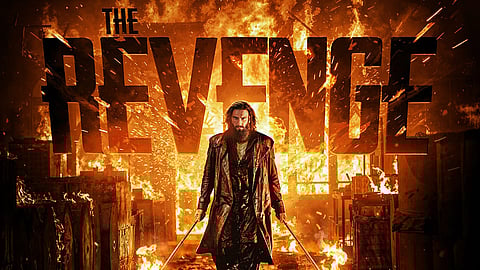
Dhurandhar The Revenge, directed by Aditya Dhar, emerges as an ambitious, high-octane cinematic spectacle that blends espionage, action, and political commentary into a sprawling narrative that seeks to redefine mainstream Bollywood storytelling. Positioned as a sequel that expands the scale and ambition of its predecessor, the film leans heavily into mythmaking, presenting a stylized world where intelligence operations, underworld networks, and national security strategies intersect in dramatic and often exaggerated ways. While its cinematic craft is undeniably polished and engaging, the film’s ideological undertones and narrative choices create a layered viewing experience that oscillates between thrilling entertainment and overt messaging.
One of the most striking narrative devices in Dhurandhar The Revenge is its incorporation of real-world political events, most notably the demonetisation announcement by Narendra Modi. The film uses this moment not merely as a backdrop but as a pivotal plot mechanism, reframing it within the context of a covert intelligence operation. Through the fictional “Operation Greenleaf,” orchestrated by R. Madhavan’s character Ajay Sanyal, the narrative suggests a larger, hidden strategy aimed at crippling terror financing networks across the border. This creative choice exemplifies the film’s broader approach—transforming complex socio-political developments into elements of a grand cinematic conspiracy, thereby reinforcing its myth-driven storytelling style.
At the heart of the film is the performance of Ranveer Singh, who portrays Hamza Ali Mazari, also known as Jaskirat Singh Rangi. His character arc forms the emotional and psychological core of the narrative, tracing a journey from vulnerability and personal tragedy to calculated ruthlessness and strategic brilliance. The film delves into his backstory, revealing how a young man with aspirations of serving in the army is transformed by circumstances into a key operative within a complex intelligence network. Ranveer Singh’s performance captures this duality effectively, balancing intensity with moments of introspection that offer glimpses into the character’s internal संघर्ष (conflict). His portrayal adds depth to a narrative that might otherwise risk becoming overly focused on spectacle.
The film’s plot unfolds across multiple layers, weaving together gang wars, political intrigue, and covert operations. Following the elimination of a key antagonist, the story shifts to the volatile landscape of Lyari, where power struggles between rival factions create opportunities for Hamza to expand his influence. By strategically manipulating alliances and leveraging his intelligence training, he infiltrates deeper into the underworld-terror nexus, positioning himself as both a participant and disruptor within the system. This progression is marked by a series of calculated moves, betrayals, and confrontations that maintain a steady narrative momentum, even as the film’s runtime stretches close to four hours.
Supporting performances by actors like Arjun Rampal, Sanjay Dutt, and others contribute to the film’s layered storytelling. Rampal’s Major Iqbal brings a sense of strategic menace, while Sanjay Dutt’s portrayal of SP Aslam adds a mix of gravitas and flamboyance. However, despite strong individual performances, the film occasionally struggles to present a truly formidable antagonist capable of matching the protagonist’s complexity. This imbalance somewhat reduces the dramatic tension, as the narrative often feels skewed in favor of the hero’s dominance.
Technically, Dhurandhar The Revenge excels in its execution. The film’s action sequences are meticulously choreographed, combining practical effects with stylized visuals to create moments that are both immersive and visually striking. From explosive confrontations to subtle, tension-filled exchanges, the direction demonstrates a keen understanding of pacing and audience engagement. The cinematography, sound design, and background score further enhance the film’s impact, creating an atmosphere that aligns with its high-stakes narrative.
However, where the film truly distinguishes itself—and simultaneously invites critique—is in its ideological positioning. The narrative often leans into a perspective that attributes a wide range of socio-political challenges to external forces, particularly across borders, while presenting domestic actions as part of a larger, meticulously planned strategy. This approach, while effective in creating a sense of cohesion within the film’s universe, can feel overly simplistic when viewed against the complexities of real-world issues. Themes such as insurgency, economic policy, and internal security are woven into the storyline in a manner that prioritizes narrative clarity over nuanced exploration.
Despite these limitations, the film remains engaging due to its ability to balance multiple genres. It transitions seamlessly between the gritty realism of a gangster drama and the calculated precision of a spy thriller, incorporating elements of both to maintain audience interest. The inclusion of inventive plot devices—such as covert operations, hidden weapons, and strategic deception—adds layers of intrigue that keep the narrative dynamic. The film’s willingness to experiment with tone and structure is evident in its ability to intersperse moments of high tension with lighter, more accessible sequences.
Another noteworthy aspect of the film is its pacing. While its extended runtime might appear daunting, the narrative structure ensures that there is a constant flow of events, preventing the story from stagnating. Moments of action are balanced with character-driven scenes, allowing the audience to engage with both the external and internal conflicts of the characters. This balance, though not always perfect, contributes to the film’s overall watchability.
In conclusion, Dhurandhar The Revenge stands as a bold and ambitious entry in the realm of Bollywood action cinema, offering a blend of spectacle, storytelling, and socio-political commentary. While its reliance on mythmaking and ideological framing may not resonate with all viewers, its technical excellence, strong performances, and engaging narrative ensure that it remains a compelling cinematic experience. The film ultimately succeeds in creating a world that is larger than life, inviting audiences to immerse themselves in its vision while leaving them to interpret its deeper implications. It is, at its core, a testament to the power of cinema to entertain, provoke thought, and spark conversation—even when it walks the fine line between reality and fiction.